— Odoo Connector

Connect Plugnotes to Odoo. Natively.

Your field forms read and feed Odoo in real-time. Customers, items, inventory, interventions, everything synchronizes after validation, without re-entry, compatible with all Odoo versions.

— Plugnotes & Odoo

Odoo manages standards, Plugnotes the on-the-ground reality

ERPs like Odoo excel in standardized and transactional processes. But operational reality doesn't always fit into predefined categories. Plugnotes doesn't aim to replace Odoo, nor to reconfigure it. It comes as an orchestration layer that adapts to your business workflows, your mobile teams, and your specific contexts, then feeds the relevant data back into Odoo. Here's the practical difference.

01
Configurable by your business teams, without development
Customizing Odoo Studio requires technical mastery of the platform. Even with AI assistance, development work still requires a developer. Plugnotes can be configured directly by your business teams, without touching your Odoo instance. Your field workflows evolve at the pace of your operations.
02
Your Odoo remains stable, your workflows remain flexible
Customizations in Odoo Studio are tied to your organization and may require adjustments with each version upgrade. Plugnotes operates as an external layer: your Odoo retains its standard configuration, and your field workflows evolve independently. The connector is maintained by Plugnotes, included in the license, and compatible with all Odoo versions.
03
Odoo for standard, Plugnotes for custom
Odoo structures standard business operations: accounting, billing, purchasing, and inventory. Plugnotes is designed for the field, where needs are dynamic, contextual, and where custom solutions are the rule rather than the exception. Your operational teams work with a solution built for their reality, while Odoo continues to serve as the foundational structure.
04
A solution designed for field teams
Scale your teams broadly with marginal-cost user accounts. Instant adoption, no prior training. Mobile app tailored for field needs, featuring offline mode, voice assistance, barcode scanning, dynamic checklists, and photo annotations.
05
Validated data before entering Odoo
Build multi-step processes with different forms, roles, and views based on user profiles. Your teams validate, complete, and enrich the data at each step. Once the workflow is complete, the information flows back into Odoo, reliable and structured.
06
Multiple Odoo data sources in a single field form
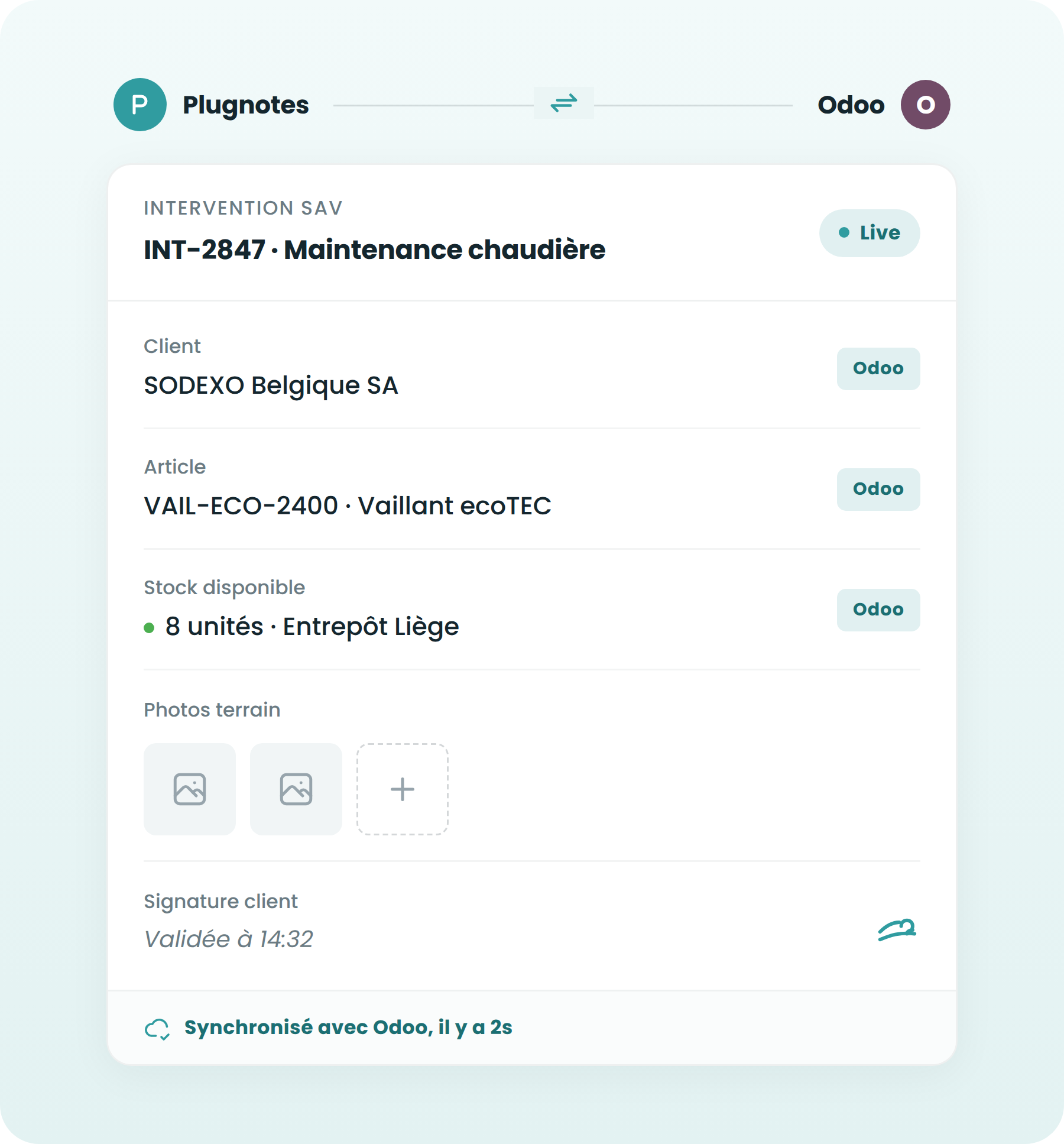
Plugnotes combines several Odoo tables into a single form, even tables that are not related to each other in Odoo. Example : a service report that simultaneously displays the Customer record, Equipment record, and Work Order, all in a single view designed for the field technician.
— Use cases

When your Odoo ERP needs data from your field teams

Intervention report in Odoo

Your technician completes their report on a mobile device. The intervention is created directly in Odoo with photos and a signature, without needing to re-enter data at the office.

See use case →

Quality controls linked to Odoo products

Field quality controls are linked to Odoo item references. Non-conformities automatically create tickets in Odoo.

See use case →

Receiving anomalies to Odoo

A damaged package upon receipt? The operator records the anomaly in Plugnotes, and a debit note is automatically created in Odoo.

See use case →

Connected production monitoring

Every machine stop, non-conformity, or batch end is recorded on a tablet and instantly uploaded to your Odoo production module.

See use case →

Work orders and site receipts

Your field teams complete their work orders via Plugnotes. Work orders are updated in Odoo upon validation.

See use case →

Digitalized supplier exchanges

Your suppliers fill out Plugnotes forms via a link. The data arrives in Odoo without intervention from your team.

See use case →

— Benefits

What you gain by connecting Plugnotes to Odoo.

Flovity-product-tools-icon
Bidirectional synchronization : Plugnotes reads your Odoo customers, items, and suppliers to populate your forms. And it sends field-collected data directly to the correct Odoo tables.
Flovity-product-tools-icon
Maintenance included in the license : connector updates are provided by Plugnotes. Compatible with all Odoo versions and no technical intervention required on your part.
Flovity-product-tools-icon
No Odoo development required : the connection is configured from the Plugnotes interface. No modifications to your Odoo instance, no third-party modules to install.
Flovity-product-tools-icon
Mobile and offline: your teams can input data even without a network connection. Data is uploaded to Odoo upon validation, whether they are in a dead zone or on a job site.
— How it works

Connect Plugnotes to Odoo
in a few steps.

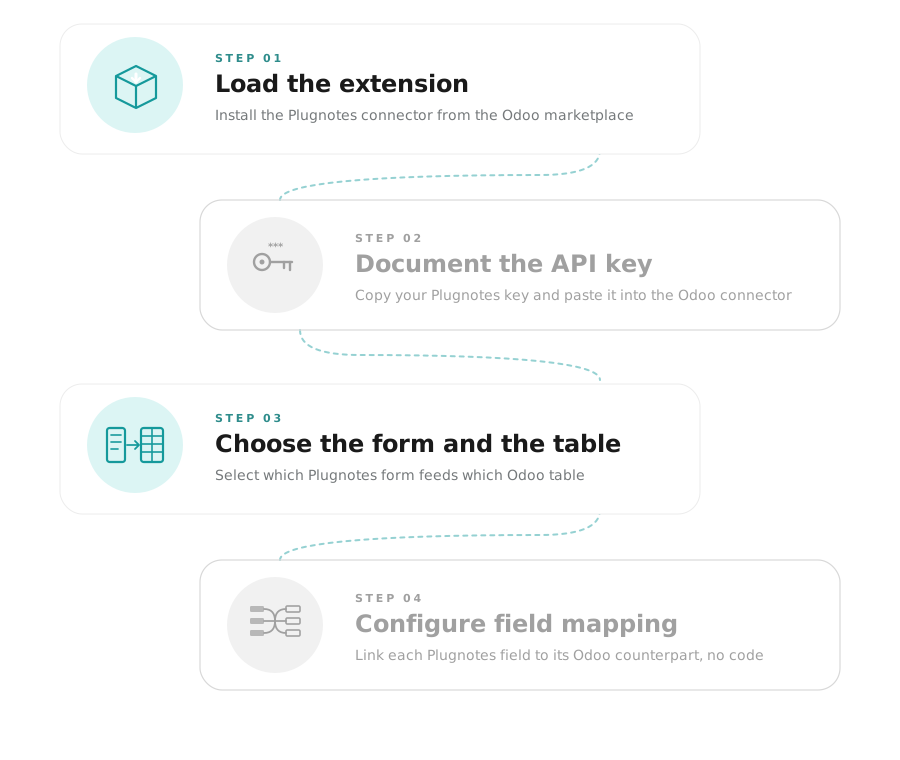
01
Load the Plugnotes extension

Install the Plugnotes connector from the Odoo marketplace. No development required.

02
Enter the Plugnotes API key

Copy your API key from Plugnotes settings and enter it into the Odoo connector.

03
Choose the Plugnotes form and Odoo table

Select which Plugnotes form feeds which table in your Odoo (customers, items, interventions...).

04
Map the fields

Link each field in your Plugnotes form to the corresponding field in Odoo. Visual, no code.
— How it works

Connect Odoo to Plugnotes
in a few steps.

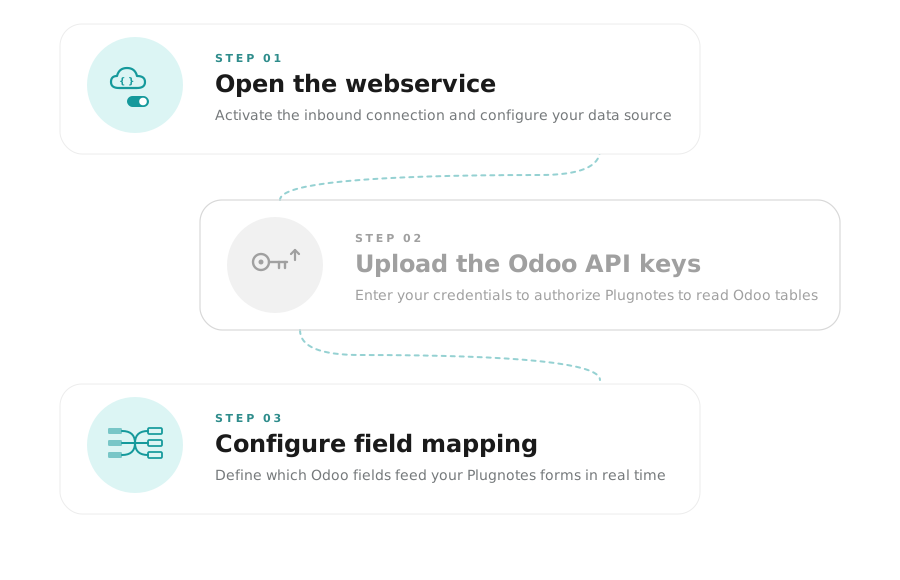
01
Open the webservice in Plugnotes

From Plugnotes, activate the incoming connection and configure the data source (customers, items, suppliers...).

02
Upload Odoo API keys to Plugnotes

Enter your Odoo credentials in the Plugnotes connection settings to authorize table reading.

03
Configure field mapping

Define which Odoo fields feed which fields in your Plugnotes forms. Data is available in real-time during entry.

— Partners

Deployed by experts
near you.

Odoo Integrators -  CERTIFIED

Odoo Integrators -  CERTIFIED

Odoo Integrators -  CERTIFIED

Odoo Integrators -  CERTIFIED

Odoo Integrators -  CERTIFIED

Let's discuss your project
Does your company use Odoo? Let's discuss your current project and challenges and see how integration with Plugnotes can help you.
— Frequently Asked Questions

Everything you want to know about the Plugnotes & Odoo connection

Which Odoo versions are compatible with Plugnotes?

Plugnotes is compatible with the latest version of Odoo SH. Connector maintenance is included in your Plugnotes license.

Do I need to modify my Odoo instance to connect Plugnotes?

No. The connector requires no modifications to your Odoo instance. Configuration is done entirely from the Plugnotes interface.

Can Odoo data (customers, items) be read from a Plugnotes form?

Yes. Your forms can be directly connected to Odoo tables: customers, items, suppliers, equipment. The operator selects a record, and the fields are automatically populated.

Is synchronization real-time?

Data is sent to Odoo when the form is submitted in Plugnotes. Reading from Odoo databases is real-time within the form.

Ready to see Plugnotes in action on your field?

Create your first form in minutes, or let us show you how Plugnotes transforms your field operations into structured ERP data.